

Golf Performance Training
The work that happens off the course, so the work on the course holds up.
Most golfers over 40 lose distance, lose accuracy on the back nine, or feel stiff for two days after a round. None of that gets fixed at the range. It gets fixed in the gym.
I coach Golf Training Minnesota for players whose handicap stopped moving even when their swing got better. That gap is almost always a body gap, not a swing gap.
WHY GOLF TRAINING
STRENGTH TRAINING FOR THE BODY UNDERNEATH THE SWING.
ROTATIONAL POWER
Distance off the tee comes from the speed your hips and thoracic spine can rotate through. Most players over 35 have lost that rotation without realizing it. We get it back.
HIP AND THORACIC MOBILITY
A swing only moves as far as your joints allow. Restricted mobility forces compensation, and compensation is where injuries start.
CORE STABILITY
Power is useless without a stable base to transfer it through. We build the trunk strength that turns rotation into clubhead speed.

Your swing coach works on technique. I work on the engine that drives it.
Strength Training For Golf Minnesota isn't generic gym work with a golf label on it. It's programmed around the four physical pieces that decide what your swing can actually do.
ENDURANCE FOR 18
The back-nine drop-off that most players blame on focus is usually fatigue. Trained correctly, you finish round 4 of a tournament weekend the way you started round 1.
WHAT WE OFFER
THE GOLF PERFORMANCE TRAINING APPROACH
This is built for players who take their game seriously. Weekend warriors who want to stop watching their drives get shorter year over year. Club players grinding through Minnesota's short season. Competitive amateurs prepping for a tournament block.
The Golf Performance Training Guide Minnesota framework I run has three pieces:
Programming written to your gaps. Not a template golf workout. A plan built around the specific pieces holding your body back from the swing you want.

An honest movement assessment. Before any programming, I look at how your body actually moves. What's locked up. What's compensating. What's strong, what's leaking power.
Coaching that adjusts with the season. Off-season build. In-season maintenance. Recovery work during tournament weeks. The work changes based on what your calendar is asking your body to do.

WHO THIS IS FOR
YOUR BODY IS HOLDING YOUR GAME BACK
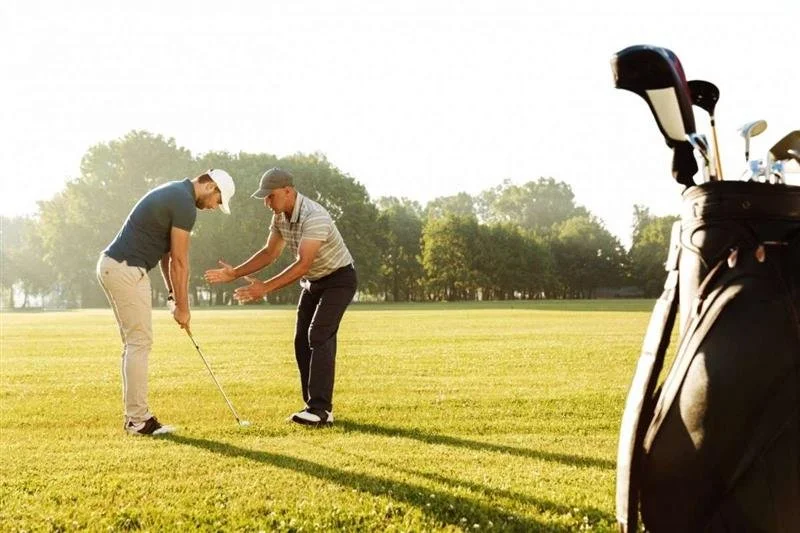
Players who are serious enough about the game to fix the part of it that isn't their swing. Most of my golf clients are professionals or business owners 35 to 55 who play frequently across Minnesota Golf Courses, from local rounds up through competitive amateur play at courses like Crystal Lakes Golf Course Minnesota.
If you've watched your handicap plateau, your distance fade, or your body break down by hole 14, this is the work that addresses it.
DISTANCE. MOVEMENT. DURABILITY.
THE BODY THAT KEEPS YOUR GAME FROM SLIPPING.
Golf performance coaching is built around your body, not your swing. The stronger, more mobile, more durable you get underneath the swing, the more your game holds up: longer off the tee, steadier on the back nine, and still standing the morning after a tournament weekend.
Every program starts with how you actually move and gets built from there. No two golfers get the same plan, because no two golfers are breaking down in the same place.
TESTIMONIAL
WHAT PEOPLE ARE SAYING
-
“This is the first time in my life I’ve seen muscle definition in my arms, back, and abs. My entire wardrobe has changed.”
—Payal P.
-
“When we met we set the goal of 10 lbs of muscle. I’m happy to say that we have not only reached that goal but exceeded it!”
—Adam C.
-
“At 34 years old, I’m in the best shape of my life, there’s no doubt that training with Garrett has changed my life.”
—Private
-
“Garrett brings the energy every day (no matter what time) and motivates me to be my best self. This is the strongest and healthiest I have ever felt in my life.”
— Kara H.
Frequently Asked Questions
-
Body work, not swing work.
I don't fix your swing technique like a swing coach would on the range. That's what your golf instructor is for. I build the body underneath the swing using Strength Training For Golf Minnesota principles.
That means rotational power, hip and thoracic mobility, core stability, and the conditioning to hold up over 18 holes without breaking down on the back nine. The goal: you drive the ball well, play at a high level as you age, and finish a round feeling strong instead of stiff and fatigued.
If you've ever wondered why your handicap stops improving even when your swing technique gets better, this is usually the answer. Your body isn't keeping up with what your swing is asking it to do.
-
It's for the player who used to be athletic and still plays competitive golf, even if "competitive" means "Saturday morning with the same four guys for fifteen years."
Most of the golfers I work with are business owners, executives, and professionals in their 40s and 50s. They've been around the game long enough to recognize that the limiting factor isn't their swing, it's their body. They want more distance, better consistency, and to still be playing the same level of golf in their 60s that they're playing now.
If you've never trained before and you're looking for a beginner program, we can defeintly meet you where you are at but it ultimately might not quite be the right fit. If you've got an athletic background and you want to apply real performance training to your golf game, you're in the right place.
-
Different job. Different room.
Your golf instructor works on technique, grip, stance, swing path, and club face. That's their world, and they're better at it than I am. My job is what happens inside your body when you swing. Rotational mechanics. The mobility to get into positions your swing requires. The strength to hit those positions consistently for four hours.
The two work together. Most of my golf clients work with me alongside their regular instruction, not instead of it. If you've been taking lessons but the changes aren't sticking, it's often because your body physically can't hold the new positions yet. That's the gap I close.
-
The clients who get the biggest results from CHP are the ones working both sides, body work with me, swing work with their instructor. The whole picture moves at once.
-
The clients who see the best results with this are typically someone who cares about playing well, plays regularly, and has an athletic foundation to build on. CHP isn't a ‘beginner” program, for golf or for anything else.
If you played sports growing up, lifted at any point in your life, or have spent years as an active person, you have what we need to work with. From there, the work meets you wherever you are.
If you're brand new to fitness and to golf, you'd be better served starting somewhere more foundational first. I'm happy to point you in that direction.
-
In many cases, yes. A lot of the back pain, hip tightness, and "I can barely move on Monday after Sunday's round" feeling that golfers carry isn't actually a back problem. It's a hip problem. Or a thoracic mobility problem. Or a core control problem.
When the rest of the body can't do what the swing needs it to do, the back gets recruited to make up the difference, and that's where the pain shows up.
The work we do addresses the actual cause, not just the symptom. Most of my golf clients tell me the body recovery part of the work was the surprise; they came for performance and got their body back in the process.
That said, if you have an active injury or a diagnosed condition, talk to your doctor or PT first. We can absolutely work alongside that care, but it shouldn't replace it.
-
Two to three times per week is the sweet spot for most clients during golf season. Off-season, we can push harder; that's where the foundation gets built for the next year of play.
The goal is to support your game, not interfere with it. You should leave training feeling better, not so wrecked you can't play your Saturday round. If a session ever leaves you in a hole for the next round, the program needs adjusting. That's the difference between training for performance and just working out.
-
In a gym. The training builds the physical capacity. Your performance shows up later, when you play at Minnesota Golf Courses, including places like Crystal Lakes Golf Course Minnesota.
-
Most golf clients run 3 sessions a week. Two strength and power sessions plus one mobility and movement session. Programs are 12 weeks minimum to see the kind of change that holds up under tournament pressure or a full season of weekend play.
-
No. The body work matters more for a 14-handicap who's plateaued than it does for a scratch player who's already optimized. You need to be someone who plays regularly and takes the game seriously enough to address what's actually holding it back.